Survival anxiety: the best reason of all to adopt AI at work
As the social psychologist Kurt Lewin famously posited:
Behaviour is a function of a Person and their Environment.
Accepting this equation, changes in behaviour are based on two differentials:
- Personal shifts – e.g. in perspective, mindset and habits.
- Environmental shifts – e.g. in levels of safety, support and feedback.
Why does this matter in the context of this article?
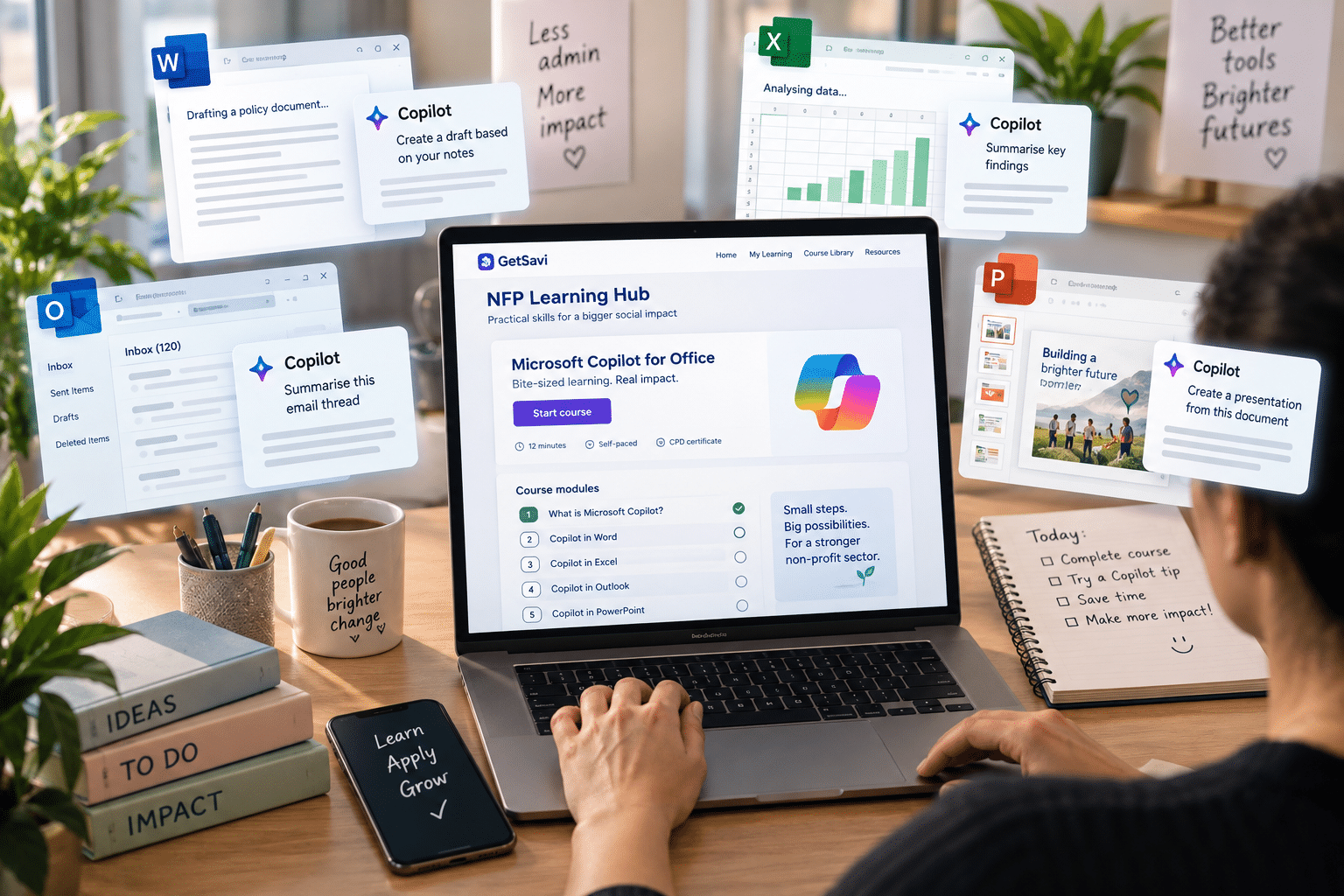
Following GetSavi’s recent launch of our NFP Learning Hub, we have developed a new suite of Microsoft Copilot for Office courses. We want you to subscribe to the Hub and use them.
However, we know that promoting the value of their features, currency and relevance to your career development alone won’t cut it.
You’re busy. You’ve got way too much on your plate to slow down and investigate how to use Word, Excel, Outlook and PowerPoint more efficiently with AI assistance.
So, in this article, we are going to use perhaps the greatest incentive of all to convince you:
Survival anxiety.
Survival anxiety – the antidote to inertia
First, a definition, if the term is unfamiliar to you.
The psychologist Edgar Schein described two phenomena that affect our ability to learn new things:
- Learning anxiety – our fear of learning something new, including the discomfort of feeling incompetent, making mistakes or exposing ourselves to others’ scrutiny.
- Survival anxiety – our fear of not learning something new, including the possibility that standing still may ultimately threaten our status, relevance or even employment.
The interesting bit is what happens when the two collide.
Change becomes much more likely when the anxiety associated with not changing becomes greater than the anxiety associated with learning something new.
But there is another way to tip the balance. Rather than simply increasing survival anxiety, we can also reduce learning anxiety by making experimentation easier, safer and less costly.
And to bring Lewin back in here, successful change therefore involves both personal and environmental shifts.
That matters enormously for AI.
Where personal avoidance holds us back
First to you.
Taking AI adoption as the very present test case here, why should you put yourself out of your comfort zone to adopt it?
Beyond a curious, tangential foray into Gen AI quick fixes – prompting, copying, pasting and offloading content to a colleague before a deadline – why should you use it?
Why indeed.
A voice in our heads, let’s call it learning anxiety, usually speaks up in its own defence:
- “Why all the fuss? I don’t need it. I’m good at my job as I am, thank you very much.”
- “How do I begin? I don’t have time to stop and learn how AI will help me in my role.”
- “Where is all this going? Scaling up my use of AI feels risky – and what about its environmental impact?”
These are all valid concerns.
Facing these apprehensions, what do we tend to do? We avoid the pain, slow down our appetite to change and hope nobody notices we’ve put this on the back burner.
Yet over time, the other voice in our minds, let’s call it survival anxiety, starts speaking up:
- “Am I falling too far behind? Others seem to have gotten their heads around AI already.”
- “If I don’t get onboard here, how long before my current career path is eroded by AI?”
- “How the heck am I going to get my head around what the futurists predict? AI as teammates?!”
And suddenly the balance begins to shift.
The discomfort of learning hasn’t disappeared. But the perceived cost of standing still is starting to look greater than the perceived cost of changing.
That is a powerful reason to act.
Where environmental inertia holds us back
Next, to your organisation.
Most would agree that the global rise of AI into the mainstream has been a change largely forced upon us. Whether free or through existing subscription payments, access to AI wasn’t necessarily brokered by us or with us.
Accordingly, many of us – that is, anyone who is not one of life’s Early Adopters or Fast Followers – responded with inertia, pushback or a very low-frequency commitment to adoption.
In the UK non-profit environment, this pushback has been heightened by three primary factors:
- In mission-driven organisations, ethics are discussed proactively. It would represent a hypocrisy if they weren’t, given why charities and other non-profits exist. AI has rightly required serious ethical attention given the speed and scale of its evolution.
- For non-profit-making organisations, failure through experimentation can be costly. Digital adoption takes time and must justify investment from limited reserves. AI is the newest change requiring careful handling within already-busy NFP digital roadmaps.
- Legacy technology and under-developed digital infrastructure remain common challenges. How can AI be embedded in the way we work when automation culture is still a work in progress? How can digital literacy be accelerated to the level required for safe and responsible AI use?
At this point in 2026, looking across the sector, despite a cacophony of content – including our own – real progress towards AI-led operations remains slow.
AI adoption is sitting in roadmap traffic waiting for the congestion to clear.
But there’s a problem with waiting.
AI itself isn’t waiting.
How anxiety provides an answer
Which brings us back to learning and survival anxiety.
As uncomfortable as both forces can be, the tension between them can provide precisely the catalyst we need for change.
Think about significant changes in the UK non-profit sector over the past decade: GDPR, cyber security, moving services online, working and furloughing through Covid-19, and subsequently adapting to blended working.
In each case, there came a point when continuing exactly as before was no longer a realistic option.
People adapted. Practice changed. And organisations developed the governance, policies, processes and culture required to catch up.
AI is different in scale and potential, but the behavioural challenge is familiar.
When the perceived cost of standing still becomes greater than the perceived cost of changing, people have a powerful reason to act.
The question then becomes: how do we make acting easier?
And the answer doesn’t necessarily begin with an organisation-wide AI strategy, a transformation programme or a major new technology platform.
It can begin with Tuesday afternoon’s PowerPoint presentation.
Tomorrow morning’s overflowing inbox.
The Word document you need to turn around before lunch.
Or the spreadsheet you have to wrestle with every month.
In other words, it can begin with the daily challenges and familiar tools already around us.
Start with what you already use
For us, Microsoft Office offers exactly that kind of daily touchpoint.
Unless you don’t use these packages at all, most of us could do with a bit more help in our daily lives inside Word, Excel, Outlook, PowerPoint and SharePoint.
That’s why we have created a suite of e-learning courses offering practical, how-to guidance for solving common Office challenges using built-in Copilot applications in the flow of work.
Our courses are self-paced, single-module and bite-sized. They are designed to be completed quickly, in or outside of work, so that people can build their AI knowledge and skills through practical experimentation rather than abstract theory.
And this is where the other half of the learning-anxiety equation becomes important.
If survival anxiety gives us a reason to change, we also need to make learning feel safer and easier.
That’s one of the reasons we developed the NFP Learning Hub: a user-friendly, subscription-based platform designed to help you and your teams accelerate learning where it may otherwise be unavailable or too expensive to access.
It provides a low-risk space for experimentation without waiting for every element of your organisation’s wider AI strategy, infrastructure or systems roadmap to fall into place.
You can start small.
Solve a real problem.
Learn something useful.
Then do it again.
And gradually, something that initially felt unfamiliar and threatening starts becoming part of the way you work.
And there you have it. That’s the pitch.
One deep psychological reason to seriously consider adopting AI more at work.
And one argument for subscribing to our Hub and completing our Microsoft Copilot for Office courses.
The pressure to change is already here.
The trick is to make taking the first step easier and safer.
Even if AI still scares the wits out of you.oking ahead.
GetSavi’s Microsoft Copilot for Office courses provide flexible, current and achievable short-form learning. A subscription also gives you access to other courses in project management, change and learning technology development within our NFP Learning Hub.
For more information about the Hub and our course library, visit the GetSavi Learning Hub.